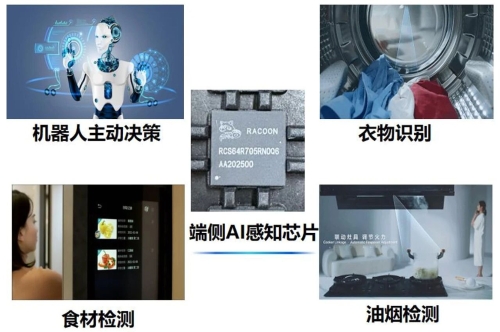
Shandong Good Achievement | The first end-to-end AI perception scene specific chip in the domestic home appliance industry, opening a new chapter in intelligent home appliances
A small chip is quietly changing our familiar home life. The air conditioner equipped with this chip can automatically lower the wind speed after you fall asleep; The refrigerator can recognize ingredients and automatically adjust the optimal storage temperature; Washing machines can automatically determine the material and degree of stains on clothes, and choose the most suitable washing mode... In June 2025, China's home appliance industry ushered in a major technological breakthrough - the first end-to-end AI perception scene specific chip was officially released in Shandong. This chip is independently developed by Qingdao Galaxy Edge Technology Co., Ltd., achieving nationwide production from architecture design to core components. It not only breaks the long-term monopoly of foreign enterprises in the field of end side AI chips, but also promotes China's home appliance industry to move from traditional single control to a new stage of multimodal perception, injecting strong momentum into "Made in China".
Technological innovation: Domestic architecture achieves comprehensive performance improvement For a long time, China's home appliance industry has faced the dilemma and practical challenges of core technology being controlled by others in the wave of intelligence. Zhang Zhikun, Vice President of Marketing at Qingdao Galaxy Edge Technology Co., Ltd., admitted that in the past, most so-called "smart home appliances" were still based on traditional general-purpose chip designs. Due to the need to rely on cloud computing, there were bottlenecks such as long response latency, high power consumption, and high risk of privacy leakage, which seriously affected the user experience. Now, this situation is ushering in a turning point with the emergence of this end-to-end AI perception scene specific chip. It is reported that the chip innovatively adopts a "nationally produced dual core heterogeneous architecture", which integrates two domestically produced cores: one is the NPU focused on AI perception and reasoning, and the other is the MCU responsible for control and data collaboration. The core components and design tools are all 100% domestically produced. In the image signal processing stage that determines the "perception ability" of smart devices, the chip has achieved a 40% improvement in visual perception accuracy through a specially optimized image processor. This means that the device can not only "see" whether there are people indoors, but also accurately judge the number of people, posture, movement trajectory, and even perceive subtle changes in human surface temperature - these multidimensional information provide a reliable perception basis for intelligent decision-making of home appliances. In terms of performance, this chip has also delivered impressive performance indicators. Actual test data shows that compared to traditional chips, power consumption has been reduced by over 30%. Response speed increased by 50%. Through the design of localized AI computing, the chip has shortened the intelligent response time from over 0.2 seconds to milliseconds, achieving a nearly real-time interactive experience. This means that when users interact with smart home appliances, the devices can immediately respond, greatly improving the smoothness and naturalness of use. In addition, it is equipped with an AI module to assist decision-making, which means that home appliances are gradually transitioning from the "remote control era" of passive command execution to the "perception era" of active perception and understanding of user needs. Industrial empowerment: driving the comprehensive upgrading of the industry At present, this end-to-end AI perception scene specific chip has been widely applied in multiple home appliance categories. For example, in air conditioning products, chips achieve more precise and intelligent temperature control by sensing real-time environmental temperature, humidity, and human activity status. When no one is detected indoors, the air conditioner can automatically enter energy-saving mode; After recognizing that the user has fallen asleep, it can intelligently adjust the operating status and provide a more comfortable sleeping environment. In refrigerator products, the intelligent experience has also been significantly improved. The chip endows the refrigerator with the ability to accurately identify the type and status of ingredients. It can not only intelligently manage the storage environment, but also provide purchasing suggestions based on the stock of ingredients. It can even automatically adjust the optimal storage temperature based on the recognition results. These features transform refrigerators from simple preservation devices to intelligent meal management assistants. In the field of washing machines, the visual perception ability of chips plays an important role. By accurately identifying the material, color, and degree of stains on clothing, the washing machine can automatically select the most suitable washing program and parameters, ensuring cleaning effectiveness while maximizing the protection of clothing fibers. This intelligent washing experience frees users from tedious program selection. As of now, this achievement has helped to increase the utilization rate of domestic chips from 3% to 30%. This leapfrog growth not only reduces the dependence of home appliance enterprises on imported chips, but also drives the development of the entire industry chain of domestic chip design, manufacturing, packaging and testing. Moreover, the application areas of this chip are constantly expanding. In the field of home security, integrating chips into smart door locks and smart cameras, the high-precision visual perception capability of chips can be used in scenarios such as intelligent monitoring and intrusion detection; In the field of home service robots, the low power consumption and efficient computing characteristics of chips provide an ideal technical foundation for the robot's environmental perception and decision-making. These expanded applications will further amplify the value of chips and drive more industries to achieve intelligent transformation. Energy Efficiency Innovation: Driving High Quality Industrial Development In the context of the "dual carbon" target, the green attributes of the chip have also attracted attention, and the low-power design of the chip has made a positive contribution to energy conservation and emission reduction. In high-definition video encoding and AI computing scenarios, power consumption has decreased by 50%, and the continuous usage time of terminal devices has doubled. After installing chips on commercial air conditioners, the average energy savings exceed 30%. If calculated based on an annual production capacity of 10 million units, carbon emissions can be reduced by more than 500000 tons per year, "said Zhang Zhikun." From the perspective of household users, low-power design reduces the operating costs of household appliances and alleviates their economic burden In addition, data is processed locally on the end side and not uploaded to the cloud, thus avoiding the risk of user privacy leakage from the source. In Zhang Zhikun's view, this chip promotes the upgrading of "Chinese intelligent manufacturing" to "precision and autonomy", filling the technical gap of domestic AI perception scene specific chips. It enables domestic home appliances to achieve a "curve overtaking" in intelligent experience, enhancing the discourse power of China's home appliance industry in the global market. Zhang Zhikun also introduced that the research and development of the next generation of products has started, focusing on two major directions: first, improving computing power, supporting more dimensional perception, integrating edge computing and lightweight AI models, and realizing integrated intelligent regulation of products; The second is to enhance intelligent AI control and improve the autonomous adjustment capability of terminal products. With the continuous iteration of chip technology and the continuous improvement of application ecology, this end-to-end AI perception scene specific chip will continue to play a core role in the intelligent process of China's home appliance industry, providing lasting impetus for promoting high-quality development of the industry and enhancing international competitiveness. Information source: Shandong Provincial Department of Science and Technology (official website)