

Understand and solve the problem of enterprise management authorization in one article!
Changing the grassroots is better than changing the top management!Today we're going to talk about modernityManagementA problem that both bosses and managers are very concerned about: stratificationauthorizationOr not layered authorization? How to authorize effectively, and what to do after obtaining authorization, which can not only reassure the boss but also maximize the effectiveness!
What is power
Power refers to a special influence that one person has over another person. Power is an influence, and the main power of a company is held by the top management, so it dominates the direction, culture, and system of the company......The influence of the higher ups is often the greatest.
The influence of power depends on dependence, for example, if a boss holds the financial resources we want, then we become dependent on the boss, and the boss has power over us.
The size of power depends on the size of this dependence, which depends on whether resources are scarce or not, important or not, and whether they can be replaced:
1.Scarcity level: If we have very abundant resources, then these resources will not increase our power. For example, for the wealthy, those who have money do not have power, only those who have scarce resources can make others rely on them. In modern enterprises, knowledge, or coordination knowledge, is often a scarce resource, so people with coordination knowledge often become the core of the enterprise.
2.Importance level: If no one is interested in the resources in your hands, there can be no dependence, so there is no power. The more important a person or department is in a company, the greater its power.
3.Irreplaceability: Irreplaceability enhances the power of a certain part or individual in the enterprise. If a certain part or employee in the enterprise cannot be easily replaced, their power will definitely be greater. No one can replace the boss, so the power of the boss is the greatest.
It seems that this statement is not specific enough. We simply understand that power is a special form of influence, and its size depends on the degree of dependence on resources. So, what specific effects does power have? Let's take a look at the father of Chinese style management:What Professor Zeng Shiqiang said:
1.contingency——powersuitableResponse: If the boss can change the cadre, the boss has the right; The supervisor has the authority to change the deployment. Power is an influence that can change others.”change“It is a word that plays a decisive role in contingency, but we should describe contingency derivatives as: powersuitableStrain. Change should be made to a reasonable level, otherwise it would be abuse of power! If the CEO authorizes us and we make random changes, how would the CEO feel.
2.permission——powerresponsibilityScope: The rights that a person possesses are very limited, and this limited right can also be said to be a person's rightresponsibilityRange. Fayol believed that wherever power is exercised, there must beresponsibilityIt can be seen that only those who are responsible can be granted power. The scope of rights and responsibilities indicates that power should prioritize responsibility over power. An irresponsible person, I believe the boss would not dare to authorize him.
In Western society, the CEO grants power first, and then the employees fulfill their responsibilities. However, in Chinese society, it is often the boss who demands that you fulfill your responsibilities first before slowly delegating power to you. Even if you can't do it well, will Chinese bosses authorize you? So this concept of order and culture needs to be judged clearly first.
3.权衡——power衡轻重:权力也是一种衡量,衡量什么呢?衡量轻重、缓急,找到那个绝佳的尺度。比如基本员工要求请假,中层主管则要用手中的权力衡量该不该批准,会有哪些不好的影响,怎么去避免。
看到这里我们应该比较清楚的知道,权力它可以用来改变东西、改变人、改变事情......在中国社会,权力它往往是先看到我们有多大的责任,然后才会我们授多大的权力;权力会权衡轻重缓急,例如特殊情况下可以先授予权力,一般而言,往往都是先负责,后授权的。
*同一时期的法约尔管理理论远比泰勒的科学管理要系统、严谨得多,即使放到现在仍然适用很多,为啥却远远不及泰勒那般”远近闻名“呢?很简单,只是因为泰勒起了个好名字叫”科学管理“,科学在西方的地位以及意义就好比上帝一般。特别是定位丛书开篇对泰勒咔咔一顿吹,特别像口嗨。科学本身是非常正确的,但多数时候,科学往往是一个工具的思维,如何利用好这个工具思维在不同环境背景下有效的使用才是我们需要考虑和注意的。
授权的好处
在之前集权是很多企业的运作法则,随着技术进步越来越快,环境越来越复杂,组织同时也越来越壮大,集权无法让企业灵活多变,迅速适应。授权越来越是一种趋势,那授权有哪些好处呢:
1.节省时间:什么事都要请示上级第一太浪费时间,第二还会养成署下不负责任的坏习惯。什么事都要请示,同时也印证该员工极度没有责任感,反正我请示了,又不是我做的决定,出了问题与我没有关系。中国的老板授权也往往选的是负责任的部署,而不是享受权力的部署,这是做部署需要注意的。
2.提高工作效率:7Elven的经营者铃木敏文,在便利店明天需要补充什么货源的问题上,就连临时工都拥有做决定的这个权力,便可以极大的提升效率。
3.降低成本:高层虽然主导企业,但是清楚知道企业运作的情况如何的往往是下属,授权可以使了解实情的部署做出最正确的决定,降低成本。
4.提升员工归属感:每个人都会有自我实现需求,强烈的自我表现欲望,授权可以帮助员工实现自我的价值,提升员工归属感。
既然授权有这么多的好处,那为啥老板总是不授权勒?是舍不得授权吗?答案肯定不是这样的,一样事物有他好的地方,则必然有其不好的地方,阴阳一定是同时存在的,多数人往往只知道授权的好处,却不会站在老板的立场上想下授权有什么坏处,高层的担忧是什么。
授权的坏处
授权当然具有很多的坏处:
1.从授权变成弄权,滥用职权:中层管理者获得授权之后,权力本来只是有限的、相对的。但权力带来相关的利益也是非常明显直接的,管理者想要掌握越来越多权力的欲望越来越不断地膨胀,渐渐的就开始玩弄权力,甚至开始滥用职权以谋一己私利。
田常得到齐简公的奖赏大权之后,便用大斗出小斗进的办法把粮食借贷给百姓,最后还谋杀了齐简公,当然现在不会有这么严重,但意思是这么个意思。所以做中层主管的一方面用权做决定,另一方面应该让老板充分的知晓,这样老板才会安心的授权。
2.授权变成分权,领导被架空:领导应该是很想授权的,否则的事必躬亲自己多累呀,部门也正是从这方面一步步分出来的。但另一方面领导也很害怕授权之后,权力被分出去收不回来了,甚至被架空。
《韩非子》中写道:子罕向君主宋桓侯建议说杀戮的刑罚是百姓所憎恨的,请让我来掌管吧。宋桓侯同意了,结果百姓都惧怕子罕,而不惧怕君主,所以宋桓侯就被劫杀了。好比古时候的皇帝一样,不授权出去自己累的要死,授权给宰相,宰相作乱;授权给宦官,宦官作乱;授权给皇后,外戚作乱等等等,类似的案例太多了,中国文化与历史历来是这样的,正是于此中国人脑筋才非常灵活,如果用来做好事那还不错,如果是走歪门邪道那也是一绝。
所以领导则需要授权之后的一个不定期的过问,为什么是不定期,如果是定期的,那心怀鬼胎的部署想要蒙蔽上面太容易了。君无术则弊于上,臣无法则乱于下,授权之后并不代表领导就撒手不管了。
3.从有责无权到有权无责:本来不授权,员工还不会怎么样,一授权之后,该负的责任忘光光,享受权利却唯恐不能尽其所用。
授权有很多的好处,问题是授权想要的到授权的好处却很难,需要的是足够的默契,彼此的信任,经常的培训,思路的清晰,还不一定可以保证达到效果。被授权的人刚开始还规规矩矩的,一段时间之后,便经不起诱惑、经不起威胁就开始滥用职权,也是常有之事。授权有授权的好处,不授权有不授权的好处,鉴于如此我们到底该怎么做呢?还是让我们看看中国式管理之父:曾仕强教授是怎么处理该问题的。
用分层负责代替分层授权
前文我们说到权力往往是和责任在一起的,所以分层负责也可以说是分层授权,负责任当然授权,不负责任授什么权。分层负责就是把责任一层一层的分割,然后给到应该拿到这个责任的员工,按照什么分割呢?所以我们给到大家一个非常重要的表格:
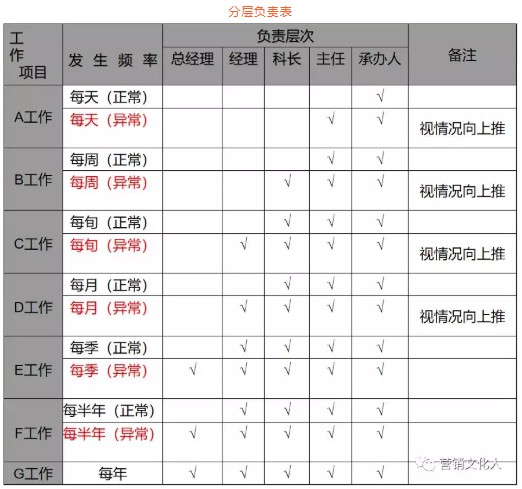
大家先简单看看这个表,对于负责层次这块的职位等级称呼,各大企业当然可以按照自己本身的等级称呼去改变,比如销售,主管,总监,总经理等......就不详细说明了。我们可以打印出这张表格,分发到每个员工手上,给他们俩个礼拜的时间,请每一个员工好好的将自己的工作列出来,大家好好分析,这个便叫做工作分析。搞清楚每个员工自己该做的事情是什么,才能找到对应的谁来承担这个责任。
大家可以看到表格中发生频率有每天对应着的工作项目,每周对应的工作项目,每旬对于的工作项目,每月对应的工作项目,每季对应的工作项目,每半年、每年对应的工作项目,把它们各自对应列出来。
1.每天:每天要做的事情,当然是基层承办人所负责的,总经理去负责那是不现实的。例如一个人的每天工作是扫地,那他每天把地扫好就可以了嘛。这种每天要做的工作项目,责任应该是非常清楚的。那这种情况是不是授权勒,大家想象一下假如每天基层承办人的扫地、开电脑、开门等工作都要向上面请示,多浪费时间呀,把处理每天工作的决定权给到基层承办人,不就是相当于授权吗?只不过是我们换个说法,改变下思路而已。
但是我们注意到下面有个每天(异常)的情况。扫地员工,每天来都把地扫好,自己负责就可以,但是突然有一天水管漏了,这就不是基层的承办人可以负责的,于是便推到上级去报告,如果事态在严重一点,主任也无法负责,就继续往上推。所以每天要做的事当然也有可能会让总经理去负责,当然那是属于异常的情况。
*推,指的不是推卸责任,而是把责任推给最能够合理的处理该责任的人。
2.每周:每周的工作一般很多都是周总结,周任务发布等,通常就不会是每天要做的工作。而每周的工作多数都会要求到上一层的主任参与的。两人一起负责,就比较放心。当然每周的时间上是可以上下浮动几天的,又不是非得固定7天。
异常情况如每天的异常情况一样,视情况一层一层往上推。
3.每旬:旬就是10天的意思,看个人企业情况具体确认要不要这么一项咯。
4.每月:每月就表示发生的频率少很多了,这种事一定会让到再上级参与到的,而且事情多数都很重大。
5.每季:我们的建议是重视季度总结,而不是年度总结。因为季度往往才符合实际情况呀,如果有落下的地方,还可以及时的弥补,等到年度总结在去补救,黄花菜都凉了。
6.每半年:一般都会惊动到经理,基层的承办人授权给他也没用呀,他怎么负责起这个责任。
7.每年:年终总结真正的作用在于增进员工之间的感情,不是真的用来总结。
我们让每个员工实实在在的把属于自己的工作写出来,整理出来之后,把频率调整排列好,凡是自己可以负责任的就不要往上推,扰烦别人,自己负不了责任的就请示。责任分明、对错分明!做好之后,试行半年,中间有什么遗漏,改善的就赶紧补上。随着时间的推进,调整过几次之后这个表一定会非常的清楚,每个员工心里有数。并且新员工进入之后,也都会一目了然!




