

Macro policies add momentum to the Chinese economy
The Central Economic Work Conference called for the continued implementation of a proactive fiscal policy and a prudent monetary policy. Looking back on 2019, what role did macro policies play in promoting high-quality development? How do enterprises and people feel? Looking ahead to 2020, how can proactive fiscal policies vigorously improve quality and efficiency, and pay more attention to structural adjustment? How can a prudent monetary policy be flexible and moderate, and maintain reasonable and abundant liquidity? Our reporter interviewed relevant experts and enterprises to explore how macroeconomic policies can further add momentum to the Chinese economy and work together to promote high-quality development.
Improving quality and efficiency——
The combination of fiscal policies is powerful
The tax reduction and fee reduction effect is significant, and the sense of gain for enterprises and residents is full
In 2019, the proactive fiscal policy has been strengthened and improved, with many highlights, among which the most prominent is the "big red envelope" of tax reduction and fee reduction, which benefits thousands of enterprises and individuals.
This is a fairer and more effective way to reduce the burden, "Lin Rujie, Deputy General Manager of Fujian Yeti Co., Ltd., told reporters that the company can pay 9.2 million yuan less value-added tax in 2019. The tax reduction policy has significantly reduced the occupation of funds, allowing us to have more funds for research and development and improving employee welfare, accumulating momentum for development
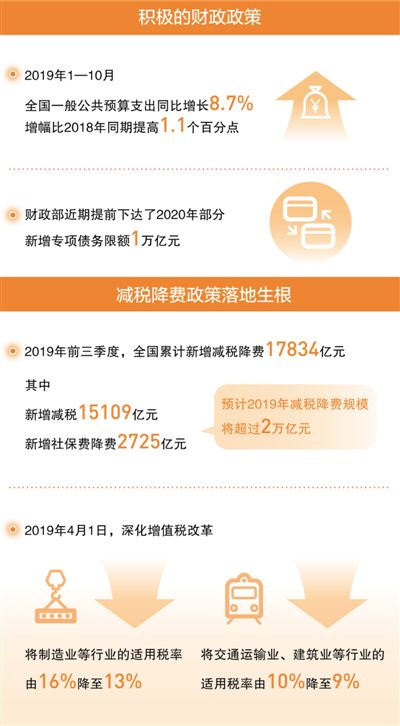
According to data released by the Ministry of Finance, in the first three quarters of 2019, China added a total of 1783.4 billion yuan in tax and fee reductions, including 182.7 billion yuan in tax reductions for inclusive policies for small and micro enterprises. Another set of data is that in the first three quarters of 2019, 45% of manufacturing taxpayers used tax reduction and fee reduction dividends to increase research and development investment; The R&D expenses of 100000 key tax source enterprises monitored by the tax department increased by 19.3% year-on-year. Like Snowman Corporation, in 2019, many companies gained an "accelerator" to climb the hill and overcome obstacles due to favorable tax and fee reduction policies.
The tax reduction and fee reduction policies have fully played a countercyclical regulatory role. Especially by lowering tax rates to reduce taxes, the policies have become more stable and transparent. Enterprises can plan for capacity increase and decrease, research and development, innovation, investment, and other aspects based on the new tax rates, making development more certain and stimulating enterprise vitality. At the same time, some residents have increased their cash income and improved their willingness to consume immediately, "said Liu Shangxi, President of the Chinese Academy of Fiscal Sciences.
Liu Shangxi believes that tax reduction and fee reduction need to be further implemented in detail to enhance the sense of gain for enterprises and residents.
Yang Zhiyong, Vice President of the Institute of Financial Strategy at the Chinese Academy of Social Sciences, suggested adjusting taxes related to consumption, which can promote domestic consumption and allow a considerable amount of overseas consumption to flow back.
Ensure expenditures in key areas and make every effort to stimulate investment
In 2019, large-scale tax and fee reductions caused a slowdown in the growth rate of fiscal revenue in some areas, but expenditures in key areas were still well protected.
Hao Lei, Deputy Director of the Budget Department of the Ministry of Finance, stated that the central government has increased its transfer payments to local governments, urged them to reduce general expenditures, and guided them to raise funds through revitalizing existing funds and state-owned resource assets.
At the same time, government departments continue to tighten their belts, vigorously reduce general expenditures, strictly control the budget for 'three public' funds, cancel inefficient and ineffective expenditures, and prioritize the use of saved funds for implementing expenditures such as ensuring wages, ensuring transportation and basic livelihood, "said Hao Lei.
In 2019, local bonds played a more prominent role in guiding investment. According to the authorization of the State Council, after 2019, the finance department may issue the new local government debt limit for the next year in advance within 60% of the new local government debt limit for that year.
Recently, the Ministry of Finance has issued a partial new special debt limit of 1 trillion yuan for 2020, accounting for 47% of the 2.15 trillion yuan new special debt limit for 2019. "Issuing some new quotas for special bonds in 2020 in advance will help expand fixed assets investment and accelerate project preparation and investment progress," said Yang Zhiyong.
According to the new regulations, special bonds can be used as capital for major projects that meet the conditions, which is equivalent to increasing the credibility of the project, leveraging the effect, and mobilizing more social capital to follow up. Zhao Quanhou, director of the Financial Research Center of the Chinese Academy of Fiscal Sciences, believes that the special bond projects that can be used as capital are mainly infrastructure projects, such as road construction and pipeline network laying, which will further drive investment in other industries.
Strengthen the linkage with policies related to currency, industry, consumption, environmental protection, etc., and enhance policy synergy
How to vigorously improve the quality and efficiency of proactive fiscal policies in 2020?
专家认为,很重要的一点是加强与货币、产业、消费、环保等政策的联动,提高政策协同性。
“比如,地方债发出去了,地方产业配套政策是否到位、相应的配套资金是否及时跟进,都可能影响财政资金的使用效率。因此,相关政策在出台和落实过程中,一定要有联动、协同的意识。”杨志勇说。
在刘尚希看来,更要关注的是各项政策之间不要形成对冲、叠加效应。
“出台政策时,应当给市场留出消化时间,充分考虑市场承受力;扶持新业态、新产业、新模式的过程中,要注重建立公平竞争的营商环境等,这些都是政策协同中应当注意的问题。”他说。
“减税降费可以涵养税基,但是在一段时间内,财政收支平衡仍存压力。而该花的钱一分不能少,特别是用于改善民生、增加优质公共服务的财政支出要保持一定规模。这就要求政府管理部门在‘减支’上想办法。”刘尚希认为,优化调整支出结构,是积极的财政政策“大力提质增效”的题中应有之义。
“要继续加强财政支出绩效管理,守好‘国库’;更重要的是,要将财政减收的压力转化为对部门一般性支出做更大力度改革的动力。”刘尚希认为,近年来对部门一般性支出的改革只是在原有基数上按比例压减,目前需要结合新的部门职能调整,对支出基数做重新核定,不必要的项目坚决减下来。(记者 曲哲涵)
灵活适度——
货币政策优供给重疏导
1月6日,央行下调金融机构存款准备金率0.5个百分点,此次全面降准将释放长期资金约8000亿元。新年伊始,央行就动用货币政策工具直接支持实体经济,保持流动性合理充裕。今年,灵活适度的货币政策会有何表现,市场很期待。
保持流动性合理充裕
“临海农商银行推出的‘年审贷’,可以一次性签订借款合同3年,其间不用我们再筹集资金还贷,无需办理任何续贷手续,贷款条件也不提高,享受的仍是免担保信用贷款。这对企业来说真是好消息!”浙江时光电缆有限公司有关负责人说。
临海农商银行副行长洪权介绍,一次性发放中期贷款,可以为企业注入金融活水,避免由于贷款期限与企业经营周期不匹配导致资金断档。
资金对企业生产经营至关重要。企业的融资情况如何,又与货币金融环境息息相关。“稳健的货币政策基调没有变,‘灵活适度’意在突出货币政策的灵活性。”民生银行首席研究员温彬说。
国家金融与发展实验室特聘研究员董希淼认为,“灵活适度”意味着货币政策将更加注重预调微调,继续保持流动性合理充裕,努力为经济高质量发展营造更加适宜的货币金融环境。
温彬认为,应引导金融机构继续优化信贷结构,确保资金流向制造业等实体经济领域。
“总体看,货币政策在流动性总量调控上会保持稳健和适度,运用多种组合流动性工具灵活地进行精准滴灌是货币政策仍将坚持的做法。并且,流动性总量将配合财政、投资、就业、产业等政策协同发力,既要保证充足,又要保证适度。”交通银行金融研究中心高级研究员陈冀说。
疏通货币政策传导
2019年,央行完善贷款市场报价利率(LPR)形成机制,报价方式改为按照公开市场操作利率加点形成,有利于疏通市场化利率传导渠道,打破贷款利率隐性下限,促进降低企业融资成本。
专家认为,深化金融供给侧结构性改革,是改善金融供给、提升供给质量的根本途径。
“深化金融供给侧结构性改革,就要优化融资结构和金融机构体系、市场体系、金融产品体系,为实体企业提供更加个性化、差异化、定制化的金融产品及服务,将流动性引向实体企业,防止金融资源脱实向虚。”陈冀说。
货币政策不能单打独斗,需要与其他政策相互配合,“几家抬”形成合力。2019年,按照“几家抬”的总体思路,小微企业金融服务工作取得了阶段性进展。人民银行金融市场司司长邹澜表示,下一步,人民银行将加强与财政、税务、工信等部门协调合作,继续发挥好“几家抬”合力,健全小微企业金融服务的商业可持续机制,着力缓解小微企业融资难融资贵问题。
比如,推动发挥国家融资担保基金作用,引导政府性融资担保机构降低小微企业融资担保费率,加大担保支持覆盖面。清理规范企业抵押登记、资产评估、过桥等附加费用,加强监测分析和监督检查,减轻企业负担。推动地方完善贷款风险补偿和分担机制,加快建设区域性小微企业信用信息共享平台,缓解银企信息不对称。
加快金融体制改革
董希淼认为,增加制造业中长期融资,应成为优化金融供给的重要发力点。可以探索专门制定针对制造业贷款的制度办法和信贷计划,加大发债、上市等直接融资力度,在防范风险前提下引导金融机构加大对制造业的支持服务。
值得注意的是,关于加快金融体制改革方面,中央经济工作会议做了周密部署和安排,对大银行、中小银行、农村信用社等均有涉及。
董希淼分析,“引导大银行服务重心下沉”,要求大型银行应改变“垒大户”“傍大款”等现象,大力发展普惠金融,加大对民营小微企业和“三农”的支持;“推动中小银行聚焦主责主业”,要求城商行、农商行等中小银行进一步端正发展理念,回归本源、扎根本地、服务本土,坚持以存款、贷款等传统业务为主要业务模式;“深化农村信用社改革”,意味着农信社要加强和深化改革,发挥服务“三农”主力军作用,提升农村金融服务能力。
Information source: China Government website




