

Deshengmen Lecture Hall focuses on artificial intelligence
On May 25th, the 12th Deshengmen Lecture Hall, hosted by the All China Federation of Industry and Commerce and organized by the All China Federation of Industry and Commerce Urban Infrastructure Chamber of Commerce and the All China Federation of Industry and Commerce Talent Exchange Service Center, was held in Beijing. The theme of this lecture is "Artificial Intelligence". More than 200 people, including Fan Youshan, Deputy Secretary of the Party Group and Vice Chairman of the All China Federation of Industry and Commerce, Li Zhantong, President of the All China Federation of Urban Infrastructure Chambers of Commerce, responsible persons of relevant departments and chambers of commerce directly under the All China Federation of Industry and Commerce, representatives of relevant enterprises and media, participated in the event.
This event is hosted by Liu Zhifeng, Chairman of Qianfan Capital and expert reviewer of the Ministry of Science and Technology's Double Innovation Competition. The conference invited several experts and experts in the field of artificial intelligence to share and discuss in the form of "keynote speeches and roundtable dialogues", aiming to focus on research achievements and experiences in core areas such as the development trend, key technologies, application fields, and industrial integration of artificial intelligence.
Cai Zixing, an international IEEE member, member of the International Academy of Navigation and Motion Control Sciences, and member of the New York Academy of Sciences, delivered a keynote speech titled "The Development History, Current Status, and Trends of Artificial Intelligence Industrialization". Cai Zixing pointed out in his speech that the essence of artificial intelligence is the ability created by humans to possess intelligent behavior. In recent years, the application scenarios of artificial intelligence have moved from a single to multiple, core technologies have accelerated breakthroughs, industries have developed strongly, and the deep integration process of artificial intelligence and the real economy is further accelerating.
Cai Zixing stated that the estimated output value of China's artificial intelligence industry in 2018 is 23 billion yuan, bringing over 100 billion yuan of growth to the real economy. But he also reminded that the development of artificial intelligence needs to be planned in a coordinated manner, avoiding a rush and disorderly competition. As technology enters a new era of artificial intelligence, we must have a correct understanding of it, neither blindly optimistic nor fearful.
The arrival of the era of artificial intelligence will enrich the connotation of the digital economy, "said An Hui, Deputy Chief Engineer of China Electronics Information Industry Development Research Institute and Secretary General of China Artificial Intelligence Industry Innovation Alliance. In the future, artificial intelligence will become the dominant digital technology, driving the transformation of the digital economy form.
Anhui proposed two directions for change: one is intelligent industrialization, which means that innovation in intelligent products will shape new growth points in the global economy. For example, from 2012 to 2017, the average annual growth rate of the global intelligent robot industry was as high as 17%, exceeding the growth rate of the vast majority of traditional industries. The second is industrial intelligence, which means that artificial intelligence will be combined with traditional industries or fields. For example, the integration of artificial intelligence and manufacturing can give rise to intelligent products, intelligent production tools, and intelligent production methods.
Chen Zhicheng, Executive Member of the Basic Committee of the Chinese Association for Artificial Intelligence and Director of the Artificial Intelligence Committee of the China Branch of the International Information Research Society, emphasized the importance of education. He pointed out that the development of artificial intelligence in China requires a huge talent base. As of now, 35 universities in China have opened undergraduate programs in artificial intelligence, and this number may increase to 100 in the next 5 years. He stated that artificial intelligence education should be extended to primary and secondary schools to cultivate young people's scientific thinking and innovative consciousness.
Jin Naigao, Vice President of China Satellite Navigation Association and Chairman of Donghe Shengda Technology Co., Ltd., pointed out that from the perspective of the long-term development of artificial intelligence in China, efforts should be made to accelerate the construction of a computing system including instructions, chips, compilers, languages, tools, networks, etc., and form its own unique advantages.
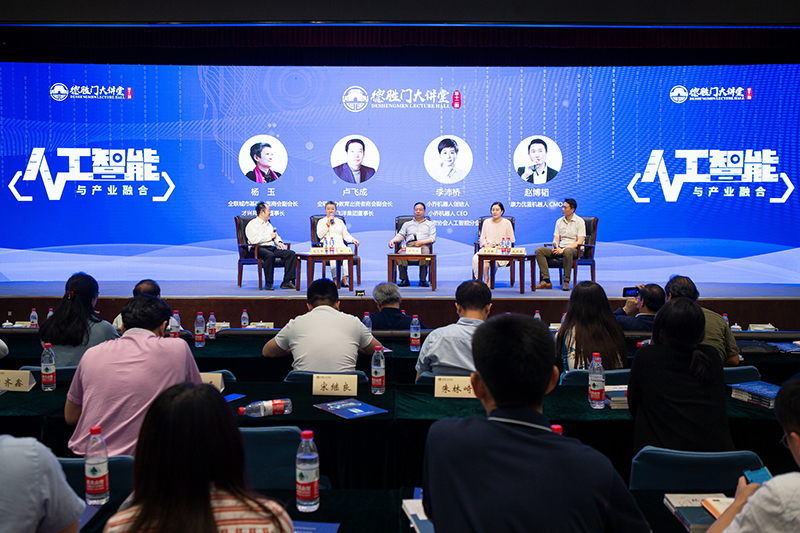
During the roundtable dialogue session, Yang Yu, Vice President of the All Union Urban Infrastructure Chamber of Commerce and Chairman of Caixingbang Technology, Lu Feicheng, Vice President of the All Union Private Education Investor Chamber of Commerce and Chairman of Feiyang Group, founder of Xiaoqiao Robotics CEO、 Li Peiqiao, President of the Artificial Intelligence Branch of the China Medical Supplies Association, and Zhao Botao, CMO of Kangliyoulan Robotics, discussed and shared their insights on the integration of artificial intelligence and industry.
本次德胜门大讲堂活动还特意安排了机器人做为迎宾小助手,并与参会人员进行了现场互动,引起了大家热情关注。
Information source: China Business Times
Edited by He Yang




