[Policy Interpretation] Controlling the New Scene: From Policy Dividend to AI Manufacturing
The General Office of the State Council's "Implementation Opinions on Accelerating the Cultivation and Opening of Scenes to Promote the Large-scale Application of New Scenes" (Guo Ban Fa [2025] No. 37) is the first time at the national level to build a "scene-driven innovation" system, crack the industrial pain points that laboratory technology is difficult to land, and introduce key policies for the deep integration of artificial intelligence and manufacturing.
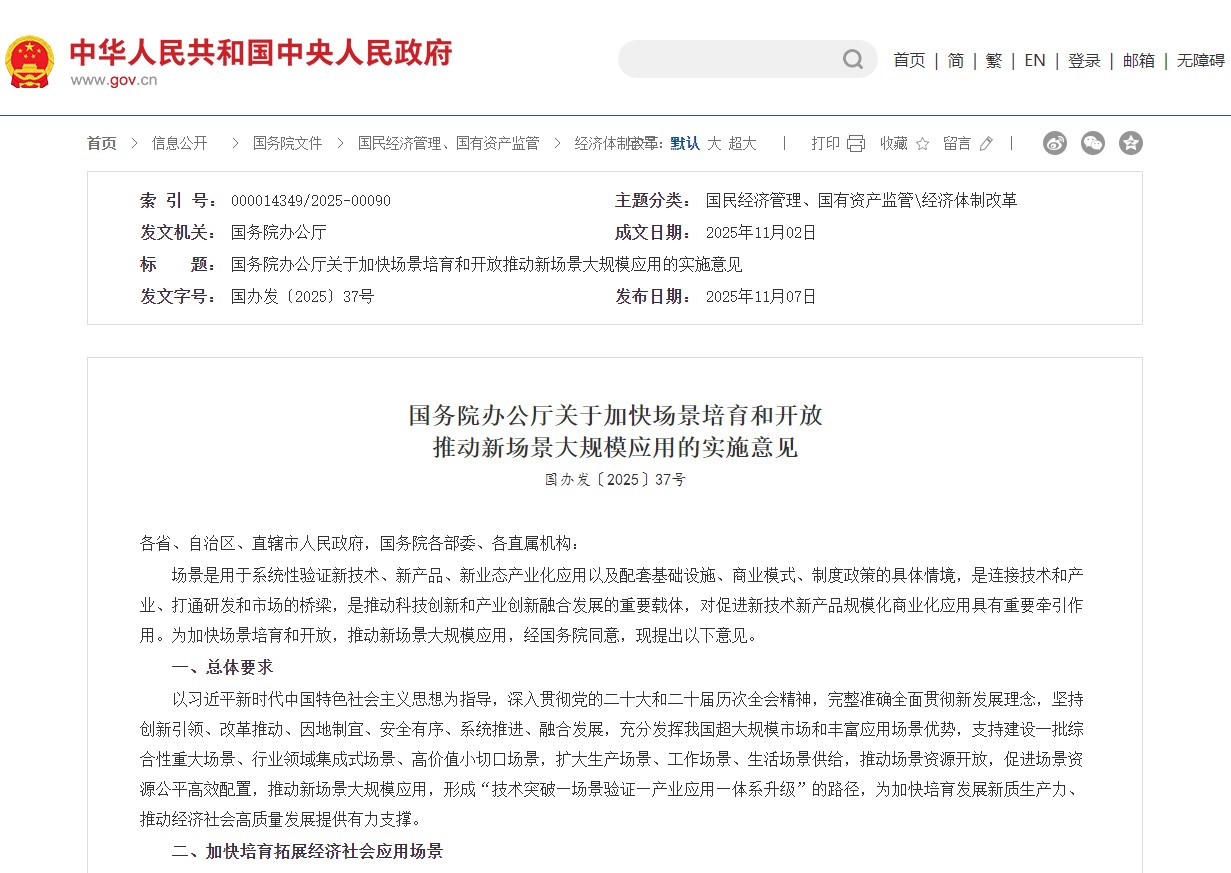
In 2026, the landing effect of this policy will accelerate. The core goal of the policy is to "build an innovation closed loop and cultivate new quality productivity", which indicates that China's innovation model is changing from simple "technology catch-up" to "scene-driven. First, in view of the current situation of insufficient conversion rate of scientific and technological achievements, the scene is used as a testing ground to verify the commercial feasibility of AI, intelligent manufacturing and other technologies, reduce the cost of trial and error of enterprises, and solve the transformation problem. The second is to shift from a linear model of traditional technology development to product sales to a cyclical model of scenario demand to technology adaptation to industrial upgrading, reshaping the logic of growth. Third, in the context of the global science and technology competition focus scene competition, seize the AI, the whole space unmanned system and other new track scene opportunities, to build the backbone of the modern industrial system, build a strong competitive advantage.
The policy plans a clear road map to build a panoramic application picture from production to life, from urban to rural areas, focusing on five major areas, covering 22 specific economic and social application scenarios. Create application scenarios for new fields and new track including digital economy, artificial intelligence, all-space unmanned system, biotechnology, clean energy and marine development, etc., and open up new ones through cutting-edge technologies such as meta-universe, virtual reality, and intelligent computing power. Economic growth point; construction of new business application scenarios for the transformation and upgrading of manufacturing, transportation, smart logistics and modern agricultural industries, promote the digital butterfly transformation of traditional industries through intelligent manufacturing, flexible production lines, intelligent traffic management and other means. Introduce application scenarios covering a series of industry fields such as emergency management, mine safety, intelligent water conservancy and construction safety, forestry and grassland, and use intelligent sensing and unmanned technology to improve the safety level of high-risk industries. Innovate comprehensive application scenarios involving government services, smart city and rural construction and other social governance services, improve the digital level of public services; enrich application scenarios covering people's livelihood fields such as health care, old-age care, culture and tourism, and cross-border integrated consumption, and improve people's quality of life through digital technology. In the process of advancing these scenarios, the policy establishes four implementation principles that must be followed. The first is to adhere to the "innovation leading, reform promoting", we must use reform methods and innovative thinking to solve the new problems in the scene construction. The second is "adjusting measures to local conditions, safety and order", emphasizing that all localities should not blindly follow the trend, must be based on their own resource endowments and industrial foundations, identify characteristic advantages, create differentiated scenes, and must maintain the bottom line of safety to ensure that they can be kept alive. Good management. The third is "system promotion, integrated development". Scene construction is not the stacking of a single technology, but the systematic integration of technology, industry, infrastructure and business models, which requires cross-domain and cross-regional collaboration. Fourth, "demand-oriented, market allocation", the cultivation of the scene must be based on the real market demand, through the establishment of market-oriented allocation mechanism, so that all kinds of subjects fair and efficient participation, to prevent the emergence of "Lalang match" type of invalid scene. These four principles delineate the boundaries for scenario construction and also provide methodological guidance.
In the face of the future factory will be through the AI of large models to optimize and reconstruct the whole production process in depth, the majority of private enterprises how to seize the opportunity in the wave of "AI manufacturing", the policy has released a clear signal: the scene resources will be fair and open to all types of ownership enterprises. We should make full use of our own advantages of flexible mechanism and sensitivity to the market, take the initiative to dig out our own pain point needs, turn these needs into specific scene opportunities, and attract AI technology providers to participate together. Adopt the strategy of "small incision, large depth", do not need to pursue the grand intelligent transformation of the whole plant at the beginning, start with a specific link, such as intelligent quality inspection and predictive maintenance, achieve rapid breakthroughs through high-value small scenes, and gradually promote them after accumulating experience; actively use various types of support provided by policies to reduce the cost and risk of applying new technologies, participate in the closed loop of scene innovation, and transform market feedback into the direction of technological improvement, So as to keenly capture needs in the cycle of "technological breakthrough" to "scene verification" and then to "industrial application, to achieve their own leapfrog development, in the future competition to occupy the first opportunity.
Commentator Guo Guangli from this website