

China's younger generation to open up a new blue ocean of low-altitude economy

This is a drone training and teaching site organized by the Human Resources and Social Security Bureau of Baiyin District, Baiyin City, Gansu Province (photographed on September 17, 2025). Photo by Xinhua News Agency reporter Cheng Nan
Xinhua News Agency, Lanzhou, January 11 (Reporter Cheng Nan) Take-off, hover, cruise, landing ...... In Baiyin City, Gansu Province, western China, 18-year-old Li Yanrong, holding a remote control in hand, successfully completed a computer-simulated drone mission under the guidance of his teacher.
Li Yanrong is a sophomore majoring in mechatronics technology in Baiyin Mining and Metallurgy Vocational and Technical College. Recently, he began to learn UAV driving at his own expense in 8000 yuan, and plans to obtain a medium-sized over-the-horizon UAV driver's license in the future. In recent years, the low-altitude economy is rapidly evolving from the concept to the new blue ocean, and more and more Chinese young people have gradually become the core driving force of industrial transformation.
"Learned the application of unmanned aerial vehicles, the future can be engaged in agricultural plant protection, intelligent inspection and other work." Li Yanrong said that he hopes to achieve better employment by mastering skills.
Li Yanrong's drone instructor, 26-year-old Wei Cunxin, agrees. "I feel like the younger generation is writing the future of the low-altitude economy," he said."
Wei Cunxin previously worked in Shenzhen for China's largest drone manufacturing company. At the beginning of 2025, because he was optimistic about the development of low-altitude economy, he resigned and returned to his hometown of Baiyin and founded Gansu ducking aviation technology co., ltd.
Wei Cunxin introduced that the company has opened a number of businesses. In addition to UAV license certification training, enterprises also carry out emergency inspection, ecological surveying and mapping and other industry application skills training, as well as to provide government and enterprise customers with a full range of low-altitude application solutions, including energy inspection, land surveying and mapping, environmental protection monitoring, agricultural plant protection, aerial photography and other software and hardware projects.
Wei Cun's new start-up company has attracted many aspiring young people to join. At present, the company has 10 employees, all of whom are young people under the age of 30.
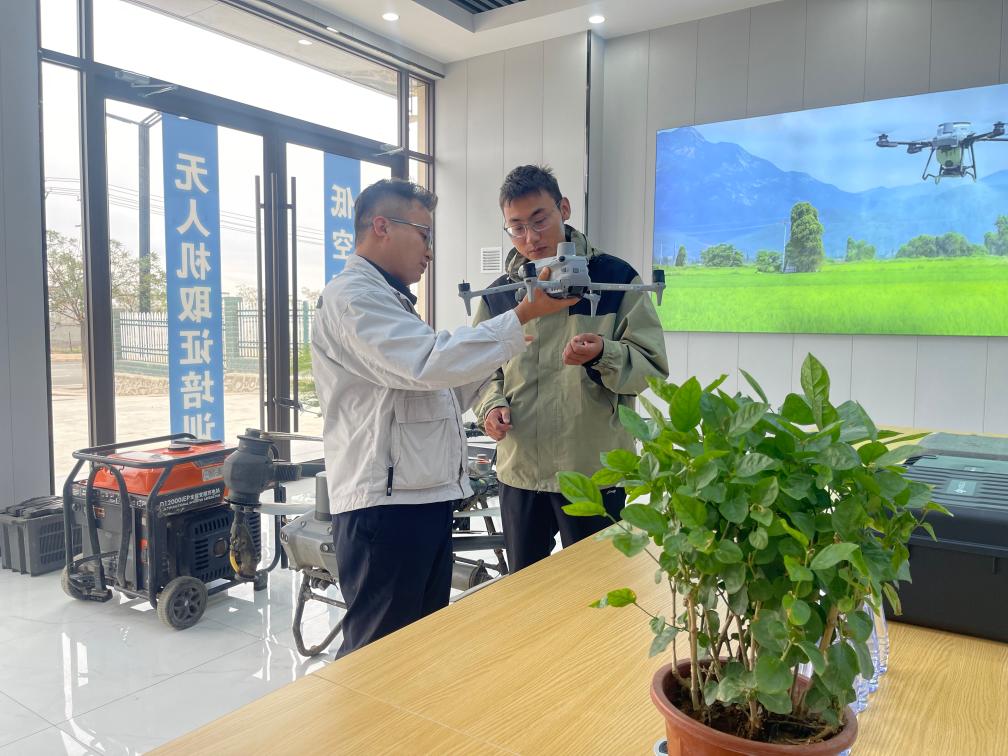
Wei Cunxin (left) communicates with colleagues (photographed on September 17, 2025). Photo by Xinhua News Agency reporter Cheng Nan
Shang Hongbo, 22, is one of them. In less than a year, he has grown into the technical backbone of the start-up. "My university's major is UAV application technology, and I am very optimistic about the development prospects of low-altitude economy." He said that in the field of local agriculture and plant protection, the income of UAV pilots is considerable.
In the past year, in Baiyin, in order to better play the role of low-altitude economy in promoting employment, relevant local departments have actively docked with professional training institutions, integrated employment training funds, and targeted unemployed people who are willing to find employment, rural migrant labor, college graduates and other groups., Launched free drone training programs through government subsidies.
"We will also recommend jobs to students to truly realize the'one-stop' service from training to employment." Gao Minqiang, a staff member of the Human Resources and Social Security Bureau of Baiyin District, Baiyin City, said that three sessions of the training have been held and more than 100 people have participated.
Wu Xuejiao, a 34-year-old Baiyin citizen, said that after training and learning, she not only mastered the basic operation skills of drones, but also understood the application of drones in agriculture, logistics and other fields. "I feel like I have an extra skill to make a living."
At the 2025 China Aviation Industry Conference, data released by the Ministry of Industry and Information Technology showed that the scale of China's low-altitude equipment industry continued to expand and the product system continued to improve. In 2024, the output value of China's civil aviation products exceeded 160 billion billion yuan, an increase of 23.6 percent over the same period last year.
In addition, the low-altitude economy has ushered in intensive deployment in the future planning of some provinces, showing distinctive regional characteristics and development paths. For example, Guangdong Province clearly proposes to take low-altitude flight as traction, focusing on infrastructure, aircraft manufacturing and normal operation; Chongqing is committed to building a "strong city for low-altitude economic innovation and development", strengthening the service platform and expanding the "low-altitude" multiple application scenarios.
Zhu Qientao, an associate professor at Lanzhou University of Finance and Economics, believes that the successive introduction of relevant plans in many places indicates that China's low-altitude economy is accelerating from top-level design to local practice and differentiation. "The future of the national industrial development pattern will be further clear, low-altitude economic prospects."
Information source: Xinhua News Agency




