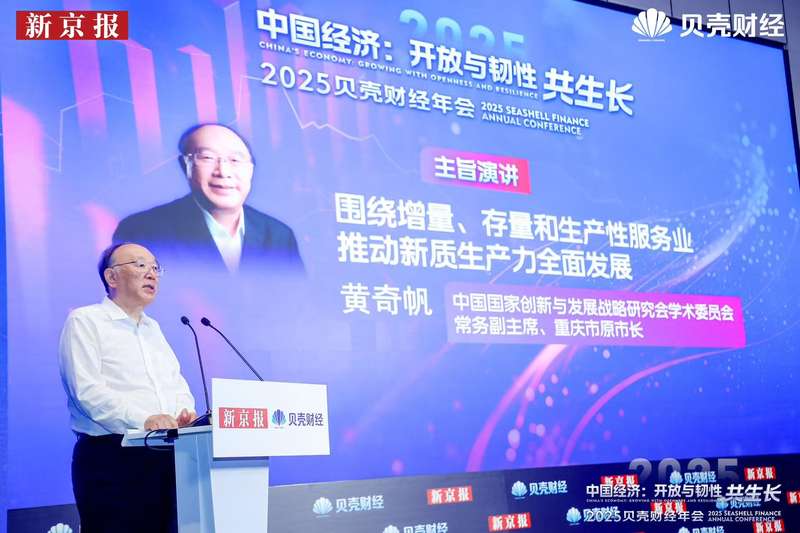
Huang Qifan: By 2040, the proportion of manufacturing industry to GDP should not be less than 25%
On July 10th, Huang Qifan, Executive Vice Chairman of the Academic Committee of the China National Innovation and Development Strategy Research Association and former Mayor of Chongqing, delivered a keynote speech at the 2025 Beike Finance and Economics Annual Conference. The following is the full text of the speech:
1、 What is productive service industry I am delighted to attend the 2025 Beike Finance Annual Conference. According to the conference theme, I would like to share with you the topic of promoting new quality productivity and focusing on the productive service industry. We all know that the United Nations has a classification definition for manufacturing and productive services, which includes 31 major categories, 179 medium categories, and 609 subcategories, totaling over 800 categories of large, medium, small, and medium-sized industries. The productive service industry, which is directly related to the manufacturing industry and promotes its development, has been established by the United Nations into 10 categories, 35 subcategories, and 171 subcategories, constituting the development of productive service industry worldwide. The productive service industry originates from and serves the manufacturing industry, running through various links of the upstream, midstream, and downstream of the manufacturing industry, and also communicating, connecting, and promoting the coordinated development between the primary, secondary, and tertiary industries. The productive service industry has emerged and driven the development of manufacturing industry, forming independent industrial sectors and forming the largest GDP sector in the world today. The productive service industry is a knowledge intensive and talent intensive industry, which is significantly different from traditional productivity industries that rely on resource factors, capital, and blue collar labor input. There are 10 major categories of productive service industries: firstly, various research and development activities centered around the manufacturing industry chain cluster, such as the development of products, semi-finished components, production lines, and assembly line equipment. The second is the development of various underlying technologies and tool technologies related to the development of the manufacturing industry. For example, the development of underlying technologies such as GPS, Beidou Navigation System, communication operating system, and chip design software. The third is services including transportation, warehousing, and logistics distribution. The fourth is the service provided by the financial industry to the manufacturing industry chain. The fifth is market access, including market access and inspection and certification services for hundreds or thousands of various enterprises and products in the entire industrial chain cluster. Six is to provide green and low-carbon services for traditional manufacturing industries. Seventh, it provides digital services for traditional manufacturing industries. Eighth is the procurement, sales, trade, wholesale, retail, and after-sales services in the manufacturing industry. Nine is the service of advertising, patents, trademarks and brands for various products. Ten is the outsourcing of various services including accounting firms, law firms, human resources, vocational training, and professional consulting institutions. These professional services fall into 10 major categories. In addition to the top 10 categories of productive service industries mentioned above, there are also 35 subcategories and 171 subcategories, which cannot be elaborated on today due to time constraints. 2、 The Five Growth Functions of Productive Service Industry What functions does the productive service industry have for our economic development through this conceptual understanding? As a service industry centered on scientific research and innovation, the productive service industry not only promotes technological progress in manufacturing and improves the efficiency and effectiveness of manufacturing operations, but also serves as a breeding ground, driving force, soil, and ecological environment for the emergence of new quality productivity and high-tech manufacturing. At the same time, the productive service industry has its own halo and is an important growth pole for the development of the world's social economy. This growth pole is manifested in five growth functions in economic development: First,It is the growth pole of GDP and often becomes the largest sector in the GDP sector of developed societies. Last year, the GDP of the United States reached $29 trillion, and the proportion of industry and agriculture in GDP increased from 60% in 1950 to 20%, with industry accounting for 18% and agriculture accounting for 2%. The life service industry used to account for 30% and still accounts for 30%, while the production service industry has increased from 10% in 1950 to 50% now. The proportion of life service industry has not changed, but its scale has increased; The productive service industry has not only increased in total volume, but also significantly increased in proportion. The GDP of the United States has increased from over 400 billion US dollars in 1950 to 29 trillion US dollars in 2024, a 70 fold increase, and the total amount of life services has also increased by 70 times. However, the productive services industry not only grows with the increase in total amount, but its proportion has also increased from 10% to 50%, accounting for 14.5 trillion US dollars out of 29 trillion US dollars. This is the largest value-added sector in the US economy. The same applies to Europe, where the proportion of productive services in the EU's GDP is 40%. The same goes for China. In 1980, China's productive service industry accounted for 10% of the $200 billion GDP at that time. Now, we have accounted for about 28%. Overall, this sector is also the most active and fastest-growing in China's GDP growth. After discussing this, we can understand that the productive service industry not only drives the development and growth of the manufacturing sector, but also serves as the largest growth pole of GDP, ultimately developing into the largest economic sector. Second,As a service industry centered on scientific research and innovation, the productive service industry is the driving force for the high-quality development of the manufacturing industry, and at the same time, it has its own halo. It is also the largest sector of unicorns in the world. For example, the stock market value of the United States is $70 trillion, of which unicorns account for roughly 30% of the market value. Among them, there are six to seven hundred small and medium-sized ordinary unicorns accounting for $5 trillion. Famous unicorns around the world, such as Microsoft, Apple, Amazon, and the seven largest companies in terms of market value, each unicorn has a market value ranging from $1 trillion to $3 trillion, with an average of over $2 trillion, totaling about $15 trillion. In addition to the seven American technology giants (Apple, Microsoft, Google's parent company Alphabet, Amazon, Nvidia, Tesla and Meta), Amazon is generally regarded as a manufacturing enterprise. Indeed, it is not only a large manufacturing enterprise, but also a large producer of services. However, it often does not directly engage in manufacturing itself, but entrusts the manufacturing work to contract manufacturing enterprises. It is mainly engaged in producer services. For example, Apple has conducted research and development on 10 major productive service industries and various aspects of operation around the Apple phone and computer industry chain, making Apple the leader of the Apple industry chain. The specific manufacturing and component manufacturing are entrusted to Foxconn or other various enterprises for OEM. The OEM enterprises produce 200 million mobile phones, which cannot be sold independently, but are handed over to Apple for global sales and after-sales service. Not only Apple, but also Microsoft's laptop development, Qualcomm and Nvidia's chip development. In summary, the largest unicorns in the United States are enterprises with productive service industry clusters as the chain leaders. Huawei in China is also such a company, producing at least five or more brands of products, including smartphones, computers, 5G base stations, automobiles, robots, etc., focusing on the development of 10 major productive service industries for each product. It has over 200000 people doing this job, and its various bases, whether it is the Shenzhen base, Dongguan base, or Shanghai base, often cover an area of two to three thousand acres. There are no production lines or blue collar workers in the building complexes of two to three million square meters, all of whom are research and development personnel. Therefore, it is China's greatest producer service industry chain enterprise, and in terms of manufacturing, it entrusts domestic Chinese enterprises such as BYD and Lixun Precision to carry out OEM production. I am saying that the productive service industry is not only a growth pole for GDP, but also a growth pole for unicorns. Third,The productive service industry is also a growth pole of service trade. In the past 40 years, service trade worldwide has increased from 5% of global trade volume to 25% now, with Europe and the United States accounting for 30% to 40%. China's service trade only accounts for 12% of the annual total trade volume, which is half of the average proportion of more than 190 countries in the world. Our inadequate development of service trade is due to the inadequate development of our productive service industry. What is service trade? Cross border services of life and production services to foreign countries constitute service trade. Last year, China's trade in goods exceeded 6 trillion US dollars, and trade in services exceeded 800 billion US dollars, accounting for about 12% of the total. A considerable part of it is the export of lifestyle services, such as tourism reception and foreign guest services, which belong to lifestyle service trade. However, the export volume of productive service industries to foreign countries is not high, with a large amount being imported. For example, when Apple manufactures 170 million mobile phones in China, it injects the top 10 productive service industries related to the Apple phone industry chain into our country's production base, taking away tens of billions of dollars in profits every year. This profit is the return on the input of productive service industries, which belongs to the service trade export of the United States and the service trade import of China. So, a large number of productive service industries have been imported into China, which is a service trade formed by capital intensive, technology intensive, and talent intensive productive service industries. However, China's own service trade exports, except for labor-intensive life service trade, are insufficient in productive service trade. Fourth,The productive service industry is the foundation of high added value products. If dismantling a mobile phone, such as a phone priced at 6000 yuan, the maximum manufacturing cost for components is 3000 yuan, and there are also 3000 yuan for invisible software, patents, intellectual property, or various programs embedded in the chip. The foundation of high added value for all manufactured products is the embedding of the value of productive services into machinery, equipment, and end products. Therefore, productive services are also the basis for improving the profit margin of manufacturing output. Fifth,The productive service industry is also the foundation for the development of total factor productivity. The productive service industry comes from knowledge intensive and talent intensive inputs, and the new quality productivity requires the improvement of total factor productivity growth beyond traditional factors, which is to focus on the development of the productive service industry. In the total economic development of the United States and Europe, 40% to 60% is driven by total factor productivity, while currently only 20% to 30% of our productivity growth is driven by total factor productivity. The reason why our proportion is low is also the result of insufficient development of productive service industries. Overall, the productive service industry has five strategic functions that we should attach great importance to. 3、 Currently, China's manufacturing industry is leading the way, and it is expected to maintain its position as the world's number one for 50-100 years. The productive service industry needs to make key breakthroughs from the 15th Five Year Plan to 2040 On the one hand, China's current economy is mainly based on internal circulation. With the promotion of the domestic and international dual circulation strategy, our economy has made significant progress, especially with the scale of Made in China now reaching over 30% of the world's total, forming the only country in the world with full coverage of industrial categories. In addition, before 2010, we did not lead in the top ten most important manufacturing sectors in the world, and basically followed behind. Now, we have five sectors that have formed a "leading" position, and five sectors have formed a "parallel running" trend with Europe and America. Therefore, the concept of China's manufacturing industry being large but not strong has now turned a new page. The 30% mentioned here is worth noting. In 2010, we were the world's largest manufacturing industry in terms of scale. At that time, our proportion was 20% of the global manufacturing industry, and the United States was 19.6% of the global manufacturing industry. The difference between the first and second places was not significant. Now our manufacturing industry is also the top in the world, but it accounts for over 30% of the total. More than 30% of the manufacturing industry in the international economy often contains two important concepts: One is the concept of three thirds. Once a country's manufacturing industry reaches the top 30% of the world's total in the international economy, there will be a huge gap between the second, third, and first places. The total manufacturing industry of other developed countries in the second, third, tenth, and twentieth places is only 30%, while the total manufacturing industry of more than 150 developing countries around the world is also around 30%. Formed three one-third states. Secondly, it is possible to maintain the concept of being the world's number one for a long time. During the 300 years of modern industrial development worldwide, there were three manufacturing countries with a 30% share of the world's largest industries, one being the United Kingdom, which maintained its position for 100 years; The second one is the United States, which has maintained it for 80 years; Thirdly, China has emerged. Will it last for 50, 80, or 100 years? Everyone can take a look, this is a remarkable new global first pattern, formed by unprecedented changes in a century. This pattern is not only different in quantity and scale from the top 20% 15 years ago, but also fundamentally different in product grade and quality. Meanwhile, five of the top ten most important sectors in the global manufacturing industry have become the kingdoms of the world's manufacturing industry. We are the kingdoms of high-speed rail, subway, and rail transit worldwide; It is the kingdom of global automobile manufacturing, with over 90 million cars produced worldwide last year and more than 30 million in China; We are the kingdom of new energy equipment production, various power equipment production, and shipbuilding. We are already ahead of the world in these five aspects. There are five areas where we have transitioned from "following" in the past to "running parallel" now, such as biomedicine, information intelligence technology including chip production, high-end equipment, new materials, aerospace, etc. Achievements that we did not have in the past have all been achieved through centralized breakthroughs in the past decade, forming a "running parallel" with Europe and America. Despite the significant achievements in China's manufacturing industry, we are relatively lagging behind in the productive service sector. Not only in terms of total quantity, but also in terms of specific connotations, the five indicators related to productive service industry are relatively weak and weak at present. First,The proportion of productive service industry is low. The proportion of Europe and America is between 40% and 50%, while China's productive service industry accounts for 27% to 30% of GDP, which is relatively low. Compared with large and developed countries, our proportion is relatively low. Second,The proportion of service trade is low. The global average proportion has reached 25%, while in Europe and America it has reached 30% and 40%. Currently, we are at 12%, which is a relatively low proportion. Third,The profit margin of manufacturing output is low. The profit margin of various equipment products and industrial products is on average 12% to 15% in developed countries in Europe and America, and the global average is 10%. China's manufacturing industry had a profit margin of 7% last year. According to theory, China's automobile manufacturing industry should have a high output and profit margin, but from January to June this year, the output and profit margin of our automobile enterprises was only 5%. The profit from selling 30 million cars last year was not as good as Toyota's profit from selling over 9 million cars in Japan. Fourth,The proportion of unicorns is low. In the Chinese stock market, unicorns account for about 10%, while in Europe and America, unicorns account for 30%. Fifth,Our proportion of total factor productivity is also relatively low. In short, from the 15th Five Year Plan period to 2040, we need to focus on eliminating the five shortcomings in economic development mentioned above, develop productive service industries, promote high-quality development of manufacturing, and promote the healthy development of new quality productive forces. I believe that during the 15th Five Year Plan period, we will achieve better adjustments in the proportion of our industrial system structure. Our current industrial system of primary, secondary, and tertiary industries accounts for about 37% of GDP structure, with manufacturing accounting for 27%, non manufacturing industries accounting for about 10%, agriculture accounting for almost 7%, and our total living and productive service industries accounting for 56%, basically half each. By 2040, what kind of ideal structural proportion should the Chinese path to modernization industrial system have? Generally speaking, the proportion of manufacturing industry is not less than 25%. Non manufacturing industries include mining, water, electricity, and other industries, with a total of 7 points, totaling 32%. Agriculture has 6 points. The production service industry should increase from the current 27% and 28% to 35%, while the life service industry should maintain 27%. The total GDP is the entire GDP. The key to making such a structural adjustment is to increase the proportion of productive service industries by 6-7 points during this process. By 2050, the further development of China's productive service industry will reach 40%, the life service industry will account for 25%, adding up to 65%. The remaining 30% will be industrial (25% manufacturing and 5% non manufacturing industries), and the proportion of agriculture will further decrease to 5%. The theme of my speech today is to promote new quality productivity and high-quality development of the manufacturing industry, and to focus on strengthening the productive service industry. That's all for now, thank you everyone! Information source: New Beijing News |