

Seagate Technology launches intelligent manufacturing reference architecture
Recently, Seagate Technology has teamed up with partners such as NVIDIA and Hewlett Packard Enterprise to create an artificial intelligence platform aimed at helping companies improve production efficiency and ensure product quality.
Seagate Technology's intelligent manufacturing reference architecture originated from the factory workshop. At the Seagate factory, the application of intelligent manufacturing enhances the control capability of chip image quality in the hard disk production process. Seagate Technology adopts this technology to improve work efficiency and product quality. In the project of Seagate Technology's factory in Thailand, engineers expect to reduce cleanroom investment by 20%, shorten manufacturing output time by 10%, and achieve a return on investment of up to 300% through the application of intelligent manufacturing.
Focus on the factory
The primary factor in achieving intelligent manufacturing is human thinking - we view and understand the world through human thinking. It is human thinking that makes various intelligent applications possible.
The human brain is inherently capable of autonomous model detection and taking proactive measures based on observation results. We can see it as some kind of self programming. Neural networks are innate skills of the brain that can recognize patterns, learn autonomously, and prevent risks, hazards, and abnormalities. It has always been a source of inspiration for programmers, engineers, and data scientists. For decades, they have been dedicated to incorporating neural networks into algorithms.
In 1959, Bernard Widrow and Marcian Hoff, electrical engineers at Stanford University, successfully created neural networks for the first time and applied them to filters to help eliminate echoes in telephone lines. The system is currently still in commercial use. However, due to the actual application of neural networks not meeting expectations, the field is facing numerous difficulties. However, over time, the development of mathematics and computation has continuously propelled its progress.
Another major breakthrough occurred in 2012, when computer scientists Geoffrey Hinton, Ilya Sutskever, and Alex Krizhevsky from the University of Toronto won the ImageNet Large Visual Recognition Challenge. The project they submitted is the AlexNet deep convolutional neural network architecture, which is still in use today and outperforms existing models by 10.8%. This project uses deep learning and graphics processing units to design image evaluation software. ImageNet contains millions of images from thousands of different categories, such as dogs, cats, cars, and more.
Bruce King, the project leader of Seagate Intelligent Manufacturing Platform and a data science and technology expert, recalled, "This was a watershed moment. For decades, people have been dreaming of such a breakthrough. And this breakthrough is the reason why Seagate's current data science, IT, and factory engineering teams can deploy artificial intelligence in our factory workshops
Scientists at the University of Toronto have successfully applied artificial intelligence neural networks and called it deep learning. Robert D. Hoff wrote in MIT Technology Review, "Deep learning attempts to mimic the activity of the neuron layer in the cerebral cortex, which is responsible for 80% of human thought formation
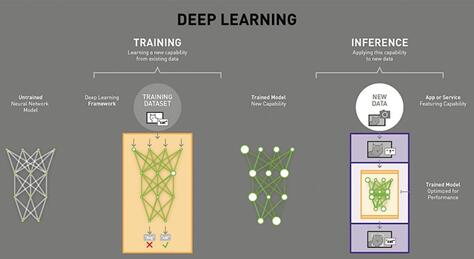
Bruce King said, "Deep learning is at the core of the Seagate Athena project, which was originally designed to improve the quality of Seagate manufacturing, and we have since developed it into the Seagate Edge RX reference architecture. It is this real-time edge computing cluster that enables Seagate to deploy machine learning functions in the factory floor. "
Rules based methods and deep learning
Precision manufacturing is a complex and arduous iterative process. Seagate produces its products in factories, and as part of production, an average of about 10 million images are generated per day. Magnetic heads are produced using processes similar to semiconductor chip manufacturing. The chip is cut into tiny read-write recording heads and then assembled into a driver.
Bruce King said, "Producing chips takes several months, including about 1000 individual steps. Many of these steps are related to quality inspection, including various forms of image acquisition. When the image shows a change in product quality, engineers must seize that point in a timely manner
Compared to other traditional, rule-based tools, state-of-the-art deep learning software can more accurately detect issues in these images.
What's different about the new tool? Bruce King said, "Algorithms themselves can learn 'what rules are' and 'when rules are violated' from data. Engineers don't need to program them." Does this mean that engineers are redundant? and be not so. New deep learning tools cannot replace engineers. On the contrary, they liberate engineers to study higher-level solutions.
The establishment of the Seagate Edge RX reference architecture benefits from Seagate's IT infrastructure knowledge, storage business expertise, partnership with HPE, ongoing research on NVIDIA's deep learning, and cluster management tools for Kubernetes and Docker.
In addition to neural networks, the rise of graphics processing units (GPUs) has also led to the arrival of the era of intelligent manufacturing. The graphics processing unit (GPU) built by NVIDIA is an ideal tool for intelligent computing, as it can perform deep mathematical learning at speeds hundreds of times faster than the central processing unit (CPU). The graphics processing unit (GPU) is different from PC microprocessors in that it can quickly and repeatedly retrieve large amounts of data and perform the same operations, "said Nathan Brookwood, the head of Insight64
Although Seagate's deep learning is implemented for manufacturing processes in the data storage industry, it is generally applicable to other types of processes, especially those with the following characteristics:
A large-scale, high-precision, distributed manufacturing process for producing tools such as semiconductors, electronics, automotive parts, and machine parts
High value manufacturing products using high cost capital equipment
Vertical industries that produce large quantities of images that cannot be analyzed using traditional methods
Anomaly detection in safe, smart cities and autonomous vehicle
A highly complex manufacturing process with multiple stages
Capable of collecting equipment, processes, and verifying dataautomationmanufacturing process
Manufacturing process driven by quality control and inspection
A lengthy manufacturing process
Multi site global manufacturing industry
Seagate Lyve Data Lab shares the Seagate Edge RX reference architecture, hoping that this reference architecture can inspire other industry professionals and be deployed in a wider range of businesses.
Srinivasan Rags, Senior Director of Seagate Emerging Verticals, said: "Seagate believes that the entire industry and ecosystem can learn from each other, complement each other, and cooperate for win-win results. Therefore, Seagate is very willing to share the edge reference architecture with enterprises with similar needs."
Article source:China IDC Circle
He Yang/Organizing and recommending




